
How to Read Binary: Complete Step-by-Step Guide for Beginners
Published January 2025 • 8 min read
Learning how to read binary is easier than you think! Whether you're studying computer science, curious about how computers work, or just want to understand your new binary clock, this guide will teach you how to read binary numbers in just a few minutes.
By the end of this tutorial, you'll be able to look at any binary number and instantly know what it represents in our everyday decimal system.
What You Need to Know Before Reading Binary
Before we dive into how to read binary numbers, let's quickly review the basics:
- Binary uses only two digits: 0 and 1
- Each position represents a power of 2
- We read from right to left (just like regular numbers)
- 1 means "on" or "active", 0 means "off" or "inactive"
If you want a deeper understanding of what binary is, check out our guide on What is Binary.
The Simple Method: How to Read Binary in 3 Steps
Here's the easiest way to read binary that anyone can master:
- Identify the position values
Each position from right to left represents: 1, 2, 4, 8, 16, 32, 64, 128, and so on (each is double the previous) - Find the "1" bits
Only look at positions that have a 1. Ignore all the 0s. - Add them up
Add together all the position values where you see a 1. That's your answer!
Example: Reading Binary 1010
Let's Read: 1010
1 0 1 0

Position 8: 1
Position 4: 0
Position 2: 1
Position 1: 0
Reading it:
- Position 8: has a 1 → Add 8
- Position 4: has a 0 → Skip
- Position 2: has a 1 → Add 2
- Position 1: has a 0 → Skip
8 + 2 = 10
Binary 1010 = Decimal 10
More Examples: Practice Reading Binary
The best way to learn how to read binary is through practice. Let's work through a few more examples:
Example 1: Binary 1111
1 1 1 1Positions with 1s: 8 + 4 + 2 + 1 = 15
Example 2: Binary 10101
1 0 1 0 1Positions with 1s: 16 + 4 + 1 = 21
Example 3: Binary 11001
1 1 0 0 1Positions with 1s: 16 + 8 + 1 = 25
The Position Value Chart
Here's a handy reference chart showing how to read binary for positions 0-7 (which covers numbers 0-255):
| Position | Power of 2 | Decimal Value | Example Bit |
|---|---|---|---|
| Position 0 (rightmost) | 2⁰ | 1 | 1 or 0 |
| Position 1 | 2¹ | 2 | 1 or 0 |
| Position 2 | 2² | 4 | 1 or 0 |
| Position 3 | 2³ | 8 | 1 or 0 |
| Position 4 | 2⁴ | 16 | 1 or 0 |
| Position 5 | 2⁵ | 32 | 1 or 0 |
| Position 6 | 2⁶ | 64 | 1 or 0 |
| Position 7 | 2⁷ | 128 | 1 or 0 |
Quick Tips for Reading Binary Faster
Once you understand the basics of how to read binary numbers, these tips will help you read them faster:
Pro Tips:
- Memorize common patterns: 1111 = 15, 11111111 = 255
- Start with the largest bit: Look at the leftmost 1 first to get a sense of the number's size
- Practice with a binary clock: Reading time in binary is excellent practice!
- Use groups of 4: Break long binary numbers into nibbles (4 bits each) for easier reading
- Know your powers of 2: 1, 2, 4, 8, 16, 32, 64, 128, 256, 512, 1024...
The Best Way to Practice: A Binary Clock
Want to know the secret to truly mastering binary? Practice it every single day. And what better way than with something you already do dozens of times daily—checking the time?
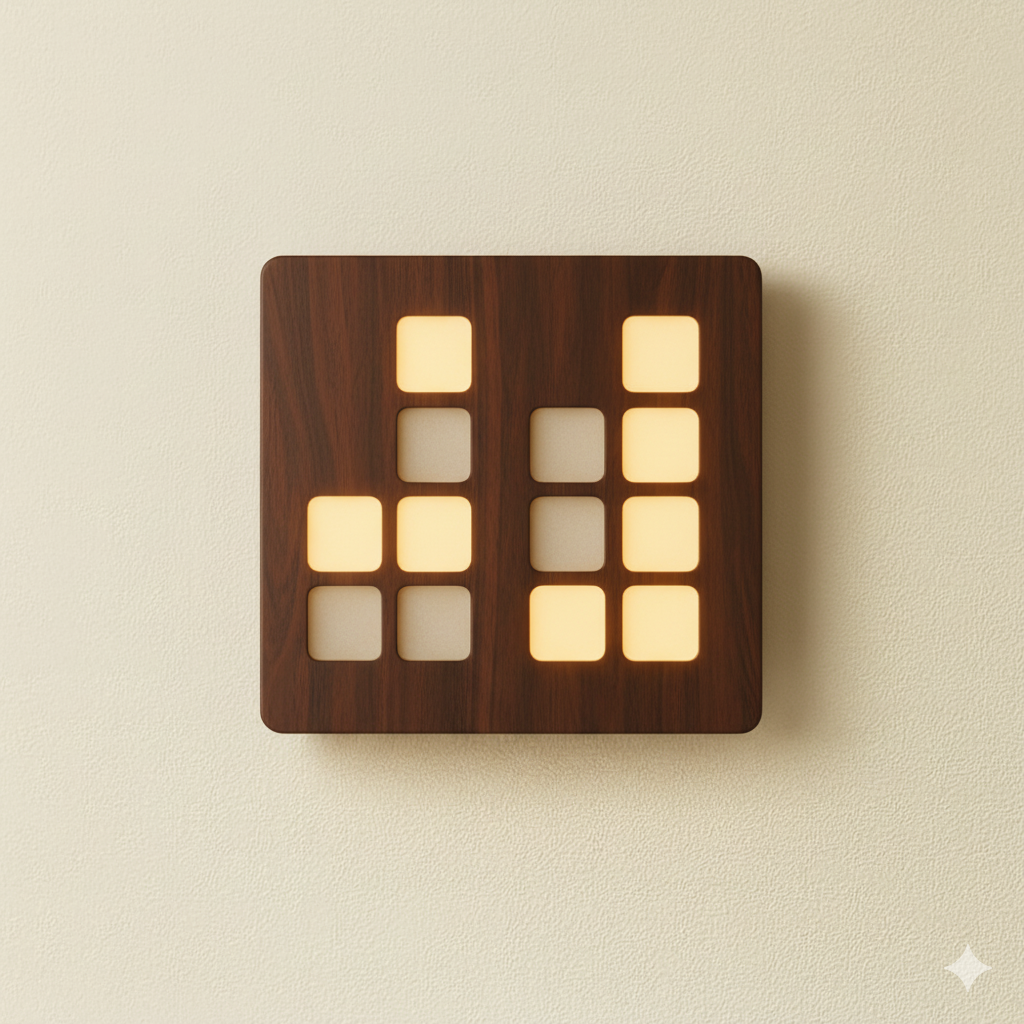
Learn Binary by Living With It
A binary clock isn't just a timepiece—it's a teaching tool that works 24/7. Every time you glance at it, you're reinforcing your binary reading skills. What feels challenging today becomes automatic within a week.
Here's how it teaches you:
- You check the time 50+ times per day = 50+ practice sessions
- Real-world context makes the numbers meaningful (not just abstract exercises)
- Pattern recognition develops naturally through repetition
- You learn to read binary instinctively, not by calculating
The Binesse binary clock displays hours, minutes, and seconds in binary using warm amber LEDs on handcrafted wood. It's beautiful enough for your desk, conversation-starting enough for your office, and educational enough for your classroom.
Common Mistakes When Reading Binary
When learning how to read binary, watch out for these common errors:
- Reading left to right: Remember, the rightmost position is 1, not the leftmost!
- Forgetting position 0: The first position (rightmost) is 2⁰ = 1, not 2¹ = 2
- Adding zeros: Only add values where there's a 1. Zeros contribute nothing!
- Miscounting positions: Double-check which position each bit is in
Practice Exercise: Test Your Binary Reading Skills
Try reading these binary numbers:
11001011010101011111111
Click to see answers
- 1100 = 8 + 4 = 12
- 10110 = 16 + 4 + 2 = 22
- 101010 = 32 + 8 + 2 = 42
- 11111111 = 128 + 64 + 32 + 16 + 8 + 4 + 2 + 1 = 255
How to Read a Binary Clock
Now that you know how to read binary numbers, you can apply this skill to reading a binary clock! A binary clock displays the time using LEDs arranged in columns, where each column represents hours, minutes, or seconds.
For example, if you see these lit LEDs in the hours column:
Lit LEDs at positions: 8 and 2
8 + 2 = 10
The hour is 10 (10:00 AM or 10:00 PM)
Learn more in our detailed guide: How to Read a Binary Clock
Tools to Help You Read Binary
As you're learning how to read binary, these tools can help verify your answers:
- Binary to Decimal Converter - Instantly convert and check your work
- How to Count in Binary - Learn the patterns of counting
- Binary Clock - Practice reading binary daily
Why Learn How to Read Binary?
Understanding how to read binary isn't just a fun party trick. It's a fundamental skill that helps you:
- Understand how computers store and process information
- Debug code and understand low-level programming
- Work with network addresses, file permissions, and bit manipulation
- Appreciate the elegance of binary logic and Boolean algebra
- Read your binary clock and impress your colleagues!
Next Steps: Beyond Reading Binary
Congratulations! Now that you know how to read binary numbers, you can explore:
- How to Count in Binary - Learn to count from 0 to 1000+ in binary
- Binary Converter Tool - Convert between binary and decimal instantly
- What is a Binary Clock - Understand how binary clocks work
- How to Read a Binary Clock - Master reading time in binary
Conclusion
Learning how to read binary is simpler than it seems at first glance. By understanding that each position represents a power of 2, identifying the 1s, and adding up their values, you can read any binary number in seconds.
The key to mastering binary reading is practice. Use a binary clock, try our binary converter, or simply practice with random binary numbers throughout your day. Before you know it, reading binary will become second nature!
In a world increasingly dominated by AI and abstraction, understanding the basics of how computers actually work—starting with binary—gives you a deeper appreciation for the technology we use every day.