
What is a Binary Clock? The Complete Guide to Understanding Binary Time
Published January 17, 2025 • 8 min read
Ever wondered what those mysterious clocks with blinking lights mean? Binary clocks are fascinating timepieces that display time using the same language computers speak: binary. In this complete guide, you'll learn exactly what a binary clock is, how it works, and why they're surprisingly easy to read.
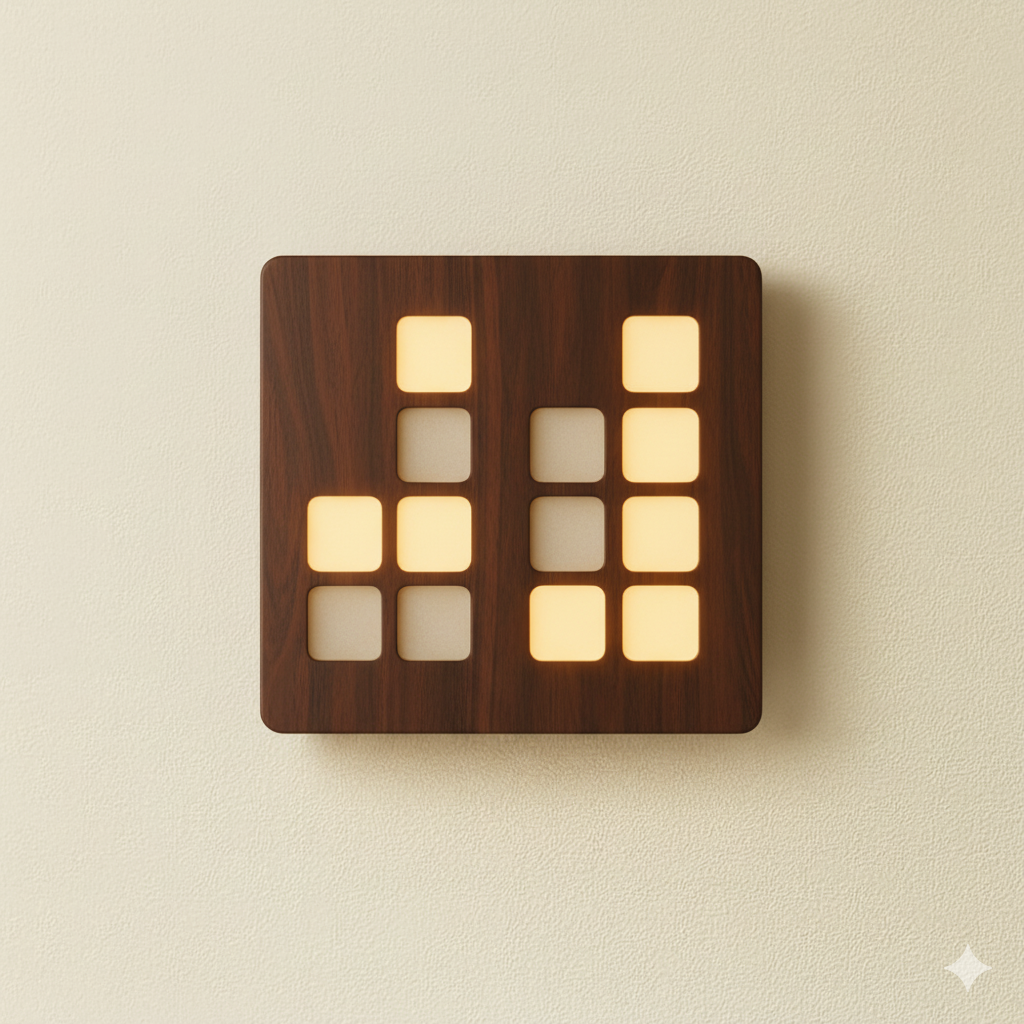
What is a Binary Clock?
A binary clock is a timepiece that displays the current time using binary numbers (base-2) instead of the traditional decimal system (base-10) we're used to. Instead of showing "3:45" with digits, a binary clock represents each number using lights or LEDs that are either on (1) or off (0).
Think of it as a clock that speaks the native language of computers. Every piece of data in your computer, from the time displayed on your screen to the videos you watch, is ultimately represented in binary (1s and 0s). A binary clock makes this fundamental concept visible and tangible.
A Brief History of Binary and Computing
Binary isn't a modern invention; it has roots dating back to ancient times. However, its application to computing began in the 1600s with Gottfried Wilhelm Leibniz, who formalized the binary number system. But binary's true power emerged in the 20th century.
Why Computers Use Binary
Computers use binary because it's the simplest number system to represent electronically. A transistor (the basic building block of computer chips) has two states: on or off, conducting electricity or not. These two states map perfectly to binary's 1 and 0.
In the 1940s, pioneers like Claude Shannon and John von Neumann realized that binary logic could be used to build computing machines. Every modern computer, from your smartphone to supercomputers, uses billions of transistors switching between these two states billions of times per second.
In a World of AI, Binary Remains Fundamental
Even as AI and machine learning become increasingly complex, everything still reduces to binary at the hardware level. Understanding binary gives you insight into the foundational layer that powers all modern computing, from simple calculations to neural networks.
How Binary Clocks Work
Most binary clocks use what's called Binary-Coded Decimal (BCD) format. Instead of converting the entire time into one giant binary number, BCD represents each decimal digit separately.
Understanding BCD Format
Let's break down the time 18:08:16 (6:08:16 PM):
- Hours: 1 and 8 (two separate digits)
- Minutes: 0 and 8 (two separate digits)
- Seconds: 1 and 6 (two separate digits)
Each of these digits gets its own column in the binary clock, represented by LEDs or lights.
The LED Pattern: Powers of 2
Each column has LEDs representing powers of 2. Reading from top to bottom:
- Top LED: 8 (2³)
- Second LED: 4 (2²)
- Third LED: 2 (2¹)
- Bottom LED: 1 (2⁰)
Example: Reading the Number 6
To display the number 6 in binary:
○ (8 = OFF)
● (4 = ON)
● (2 = ON)
○ (1 = OFF)
4 + 2 = 6
The Complete Layout
A full binary clock displaying hours, minutes, and seconds has six columns:
- Hours (tens): Usually needs only 2 LEDs (0-2)
- Hours (ones): Needs 4 LEDs (0-9)
- Minutes (tens): Needs 3 LEDs (0-5)
- Minutes (ones): Needs 4 LEDs (0-9)
- Seconds (tens): Needs 3 LEDs (0-5)
- Seconds (ones): Needs 4 LEDs (0-9)
This creates the characteristic 2-4-3-4-3-4 LED pattern you see on most binary clocks.
Why Binary Clocks are Fascinating
1. They Make Abstract Concepts Tangible
Binary is often taught through diagrams and theory. A binary clock lets you see and interact with binary constantly. Every time you check the time, you're practicing binary conversion.
2. They're Actually Educational
Computer science students, programmers, and engineers use binary clocks as study aids. Understanding binary deeply helps with:
- Bitwise operations in programming
- Understanding computer architecture
- Network addressing and subnetting
- Data structures and algorithms
- Low-level system programming
3. They're Conversation Starters
A binary clock on your desk or wall immediately sparks curiosity. It's an opportunity to explain fundamental computing concepts to friends, family, or colleagues, and show off your technical knowledge.
4. They Celebrate Elegant Solutions
Binary is the most efficient number system for digital electronics. A binary clock is a reminder that the most elegant solutions are often the simplest. Just two states (on and off) can represent any number, any data, any information.
Quick Tutorial: How to Read a Binary Clock
- Identify the six columns (two for hours, two for minutes, two for seconds)
- In each column, look at which LEDs are lit
- Add up the values of the lit LEDs (8 + 4 + 2 + 1)
- That's your digit! Repeat for all six columns
With just a few practice rounds, you'll be reading binary time effortlessly.
Different Types of Binary Clocks
BCD Binary Clocks (Most Common)
As described above, these use Binary-Coded Decimal format. Each decimal digit is represented separately in binary. This is the easiest type to learn and the most popular.
True Binary Clocks
These represent the entire time as a single binary number. For example, 18:08:16 would be converted to total seconds (65,296 seconds since midnight) and displayed as one binary number. These are significantly harder to read!
Simplified Binary Clocks
Some binary clocks show only hours and minutes, omitting seconds. These are more compact and easier to learn on.
Binary Clock Kit vs Pre-Built: Which is Right for You?
If you're interested in owning a binary clock, you have two main options: binary clock kits (DIY assembly) or pre-built binary clocks. Each has its advantages:
Binary Clock Kits (DIY)
- Educational Value: Soldering and assembling a binary clock kit teaches electronics fundamentals
- Customization: Binary clock kits often allow color choices, case modifications, and programming
- Lower Cost: DIY kits are typically cheaper than pre-built options
- Satisfaction: Building your own binary clock kit gives you pride of creation
- Best For: Hobbyists, students learning electronics, makers who enjoy soldering
Pre-Built Binary Clocks
- Ready to Use: Works out of the box with no assembly required
- Premium Quality: Professional finish with handcrafted wood and precision calibration
- Reliability: Tested and backed by warranty (5 years for Binesse)
- Gift-Ready: Perfect for giving without requiring technical skills from the recipient
- Best For: Gifts, professional office settings, those who want guaranteed quality
While a binary clock kit is excellent for hands-on learning, a pre-built option like Binesse offers premium craftsmanship with all-natural shellac wood finish, non-toxic materials, and a lifetime of reliable use.
Who Uses Binary Clocks?
- Software Developers & Programmers: A reminder of fundamental concepts in their workspace
- Computer Science Students: Hands-on learning tool for binary number systems
- Teachers & Educators: Interactive teaching aid for demonstrating binary
- Engineers & Makers: Appreciation for elegant solutions and technical design
- Tech Enthusiasts: Conversation piece that showcases technical interests
- Anyone Learning to Code: Makes binary accessible and fun
Experience a Handcrafted Binary Clock
Binesse combines premium wood craftsmanship with precision binary time display. Perfect for learning, teaching, or showcasing your technical passion. Founder pricing at $249. Ships Summer 2026.
Reserve a Binesse Binary Clock →Frequently Asked Questions
What is a binary clock?
A binary clock is a timepiece that displays the current time using binary numbers (1s and 0s) instead of traditional decimal digits. Most use Binary-Coded Decimal (BCD) format, where each decimal digit of the time is represented separately in binary using LED lights.
How does a binary clock work?
Binary clocks use LED lights to represent binary digits. Each column represents a digit of time (hours, minutes, seconds), and each LED in that column represents a power of 2 (8, 4, 2, 1 from top to bottom). You add up the lit LEDs to get the decimal value.
Is it hard to read a binary clock?
Not at all! Most people learn to read a binary clock in 5-10 minutes. Once you understand that each column is just adding up powers of 2 (8, 4, 2, 1), it becomes second nature. The repetition of checking the time helps reinforce the concept.
Why would someone want a binary clock?
Binary clocks are popular among developers, CS students, teachers, and anyone interested in how computers work. They're educational, conversation-starting, and serve as a constant reminder of the fundamental building blocks of computing.
What's the difference between BCD and true binary clocks?
BCD (Binary-Coded Decimal) clocks represent each decimal digit separately in binary, much easier to read. True binary clocks convert the entire time into one binary number, which is significantly more challenging to interpret quickly.
Can binary clocks teach you programming?
While a binary clock won't teach you programming directly, it helps build foundational understanding of binary number systems, which is essential for low-level programming, bitwise operations, and understanding computer architecture.