
What is Binary? The Complete Beginner's Guide to the Binary Number System
Published January 17, 2025 • 12 min read
Binary is the language that powers every computer, smartphone, and digital device you use. But what exactly is binary? In this complete guide, you'll learn what binary means, how binary numbers work, and why binary is the foundation of all modern computing.
What is Binary? The Simple Answer
Binary is a number system that uses only two digits: 0 and 1.
That's it! While our everyday number system (called "decimal" or "base-10") uses ten digits (0 through 9), binary uses just two. Think of it as the simplest possible counting system.
Binary is also called "base-2" because it's based on powers of 2, just like decimal is based on powers of 10.
0 1 10 11 100 101These are the first six numbers in binary (0, 1, 2, 3, 4, 5 in decimal)
Why is Binary Important?
Binary isn't just a neat mathematical curiosity — it's the foundational language of all digital technology. Here's why:
Every Computer Speaks Binary
At the most fundamental level, computers can only understand two states: electricity flowing (1) or not flowing (0). Every calculation, every piece of data, every program on your computer is ultimately represented as millions (or billions) of 1s and 0s.
When you type a letter, watch a video, or play a game, your computer is processing binary numbers at incredible speeds—billions of 1s and 0s per second.
Binary is Universal in Computing
- All data storage uses binary (hard drives, SSDs, USB drives)
- All communication uses binary (WiFi, Ethernet, Bluetooth)
- All processing uses binary (CPU calculations, graphics rendering)
- All programming ultimately compiles to binary (machine code)
What is a Binary Number?
A binary number is simply a number expressed using only 0s and 1s. Just like decimal numbers can represent any quantity, binary numbers can too—they just look different.
Same Number, Different Representations
The number "ten" can be written as:
- Decimal (base-10): 10
- Binary (base-2): 1010
- English words: "ten"
- Roman numerals: X
They all represent the same quantity—just written in different systems!
How Does Binary Work?
Binary works just like our regular decimal system, but with powers of 2 instead of powers of 10.
Understanding Decimal First
In decimal, each position represents a power of 10:
5,432 means:
5 × 1000 (10³)
4 × 100 (10²)
3 × 10 (10¹)
2 × 1 (10⁰)
Binary Works the Same Way (But with 2s)
In binary, each position represents a power of 2:
1011 means:
1 × 8 (2³)
0 × 4 (2²)
1 × 2 (2¹)
1 × 1 (2⁰)

= 8 + 0 + 2 + 1 = 11 in decimal
The Key Insight
In binary, each position to the left doubles in value (1, 2, 4, 8, 16, 32, 64, 128...). In decimal, each position to the left multiplies by 10 (1, 10, 100, 1000...). Same principle, different base!
What is Binary Code?
Binary code is information represented as sequences of 1s and 0s. It's how computers store and process all data.
Text in Binary Code
Each letter and symbol is assigned a binary number. For example, in the ASCII encoding system:
| Letter | Binary Code |
|---|---|
| A | 01000001 |
| B | 01000010 |
| C | 01000011 |
So the word "CAB" in binary code would be: 01000011 01000001 01000010
Everything is Binary Code
- Images: Each pixel's color is stored as binary numbers
- Music: Sound waves converted to binary digital audio
- Videos: Combinations of binary image and audio data
- Programs: Instructions written in binary machine code
Why Do Computers Use Binary?
This is one of the most asked questions about binary. The answer is both simple and profound.
It's the Easiest to Build
Creating electronic circuits that reliably distinguish between TWO states (on/off, high voltage/low voltage) is much easier than building circuits that can distinguish between ten states (which would be needed for decimal).
It's Noise-Resistant
Binary signals are clear: a signal is either present (1) or absent (0). This makes binary extremely reliable. Even if there's electrical noise or interference, it's easy to tell if a signal should be interpreted as 1 or 0.
Binary Logic is Mathematical
The mathematician George Boole discovered that logical operations (AND, OR, NOT) could be performed using binary. This "Boolean logic" became the foundation for digital circuit design. Every modern computer is built on billions of tiny logic gates that perform binary operations.
Binary in Everyday Life
Even if you don't realize it, you interact with binary constantly:
- Light switches: Binary (on or off)
- Yes/No questions: Binary choices
- True/False tests: Binary logic
- QR codes: Patterns of binary data (black = 1, white = 0)
- Barcodes: Binary encoded product information
Learning Binary: Why It Matters
For Students & Professionals
- Computer Science: Understanding binary is fundamental to CS education
- Programming: Helps with bitwise operations, optimization, and debugging
- Networking: IP addresses and subnet masks use binary
- Security: Encryption and hashing rely on binary mathematics
In the Age of AI
As AI and machine learning become more prevalent, understanding the fundamentals becomes even more important. Binary is the bedrock—everything from simple calculations to neural networks ultimately reduces to binary operations at the hardware level.
Learn Binary the Fun Way
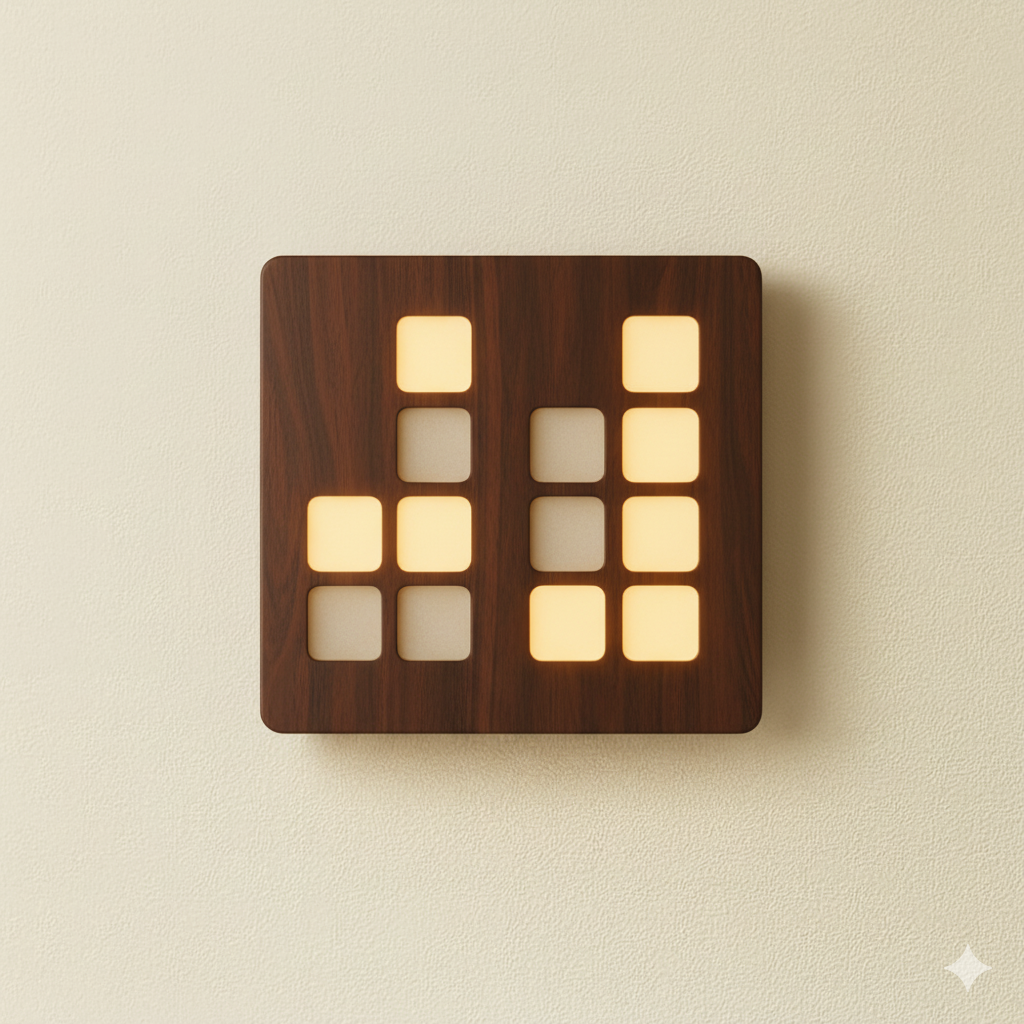
The Binesse binary clock makes learning binary natural and enjoyable. Every time you check the time, you practice reading binary. Founder pricing at $249. Ships Summer 2026.
Explore the Binesse Binary Clock →Frequently Asked Questions About Binary
What is binary?
Binary is a number system that uses only two digits: 0 and 1. It's called "base-2" because it's based on powers of 2. Every piece of data in computers is ultimately stored and processed as binary numbers.
Why do computers use binary?
Computers use binary because it's the simplest number system to represent electronically. Transistors (the building blocks of computer chips) have two states: on (1) or off (0). These two states perfectly match binary's 0 and 1, making binary the ideal language for digital electronics.
What does binary code mean?
Binary code is information represented as sequences of 1s and 0s. For example, the letter 'A' in binary code is 01000001. Everything in your computer—text, images, programs—is stored as binary code.
Is binary hard to learn?
No! Binary is actually simpler than decimal because there are only two digits to remember. Most people can understand basic binary counting in 10-15 minutes. With practice (like using a binary clock), you become fluent quickly.
What is the binary number system?
The binary number system is a way of representing numbers using only 0s and 1s. Each position in a binary number represents a power of 2 (1, 2, 4, 8, 16, 32...), just like each position in decimal represents a power of 10.
How is binary used in real life?
Binary is everywhere in technology: all digital storage (hard drives, USB drives), all digital communication (WiFi, internet), all digital processing (smartphones, computers), digital displays, QR codes, barcodes, and more. Every digital device uses binary at its core.
Keep Learning About Binary
Ready to deepen your understanding? Check out these resources:
- How to Count in Binary - Step-by-step tutorial from 0 to 100
- What is a Binary Clock? - Learn about the most fun way to practice binary
- Binary to Decimal Converter - Free tool with explanations
- Binesse Binary Clocks - Make binary part of your daily life